Hedge Trimming Millbank — Recycling and Sustainability Promise
At Hedge Trimming Millbank we combine expert Millbank hedge trimming services with a clear commitment to environmental stewardship. Our approach to waste and garden debris goes beyond simple collection: it is a planned, measured strategy to reduce landfill, lower carbon emissions and return organic material to local green spaces. We treat every hedge clipping and pruned branch as a resource. Our aim is to build a resilient, eco-friendly waste disposal area and a sustainable rubbish gardening area that serves residents across Millbank and neighbouring boroughs.
 We know local authorities in Westminster and neighbouring boroughs support kerbside separation of paper, glass, food and garden waste, and we align our operations with those schemes. By integrating Millbank hedge trimming workflows with borough-level recycling streams we increase diversion from residual waste and make it easier for households and businesses to benefit. Hedge trimming Millbank is therefore not just a service — it is a node in a wider circular system that respects local waste separation practices and targets.
Our Recycling Percentage Target and Measurement
We have set a clear recycling percentage target: 75% of all green and hard landscaping waste will be recycled or reused by 2028. This target covers wood chippings, composted green waste, reusable soil, metal fixings and any salvageable hard landscaping materials collected during Millbank hedge-care and garden maintenance operations. Progress is tracked quarterly using weight-based reporting and route-level data from our low-emission fleet.

Local Transfer Stations and Waste Handover
Our routes include scheduled visits to authorised local transfer stations and depots that serve Central London and Westminster. Typical transfer hubs we work with are the council-approved waste transfer facilities that accept segregated garden waste, wood, and inert material for composting and further processing. Working closely with these stations ensures that material from a Millbank hedge trimming task goes straight into the correct stream — for example, chipped wood for biomass or mulch, green waste for municipal composting, and metal or plastic components for recycling.
We also maintain partnerships with local charities and community organisations to maximise reuse. Through collaborations with community gardens, city farms and local environmental charities we redirect healthy plants, pots, timber offcuts and soil where appropriate. These partnerships deliver social value: surplus topsoil can support community allotments, and reclaimed timber finds new life in raised beds. Our charity partners take items that are fit for reuse and repurpose, reducing the volume of material entering the formal waste stream.
Fleet decarbonisation is central to our sustainable rubbish gardening area strategy. We operate a mix of low-carbon vans: battery-electric vans for short urban routes, plug-in hybrids for mixed journeys, and Euro 6 diesel units only where necessary for longer haul trips to transfer stations. Route optimisation software reduces mileage and idle time, and driver training emphasises eco-driving techniques. Millbank garden waste collections are scheduled to maximise load consolidation and minimise emissions per kilogram of material moved.
Our recyclable activity mix reflects what local boroughs expect: separation of garden waste from food and mixed recycling, on-site chipping for woody material, and careful segregation of contaminants. To be explicit, our core recycling activities include:
- Green waste composting and municipal handover
- Wood chipping for mulch and biomass feedstock
- Soil reuse and screening for community projects
- Metal and plastic component recovery and transfer to material-specific streams
Implementation in public and private sites follows strict protocols: waste is assessed at source, separated where feasible, and bulked for collection under the correct authority guidelines. We document contamination rates and work with property managers to reduce non-compliant disposal, supporting borough campaigns that emphasise separate containers for paper, glass, food, and garden refuse.
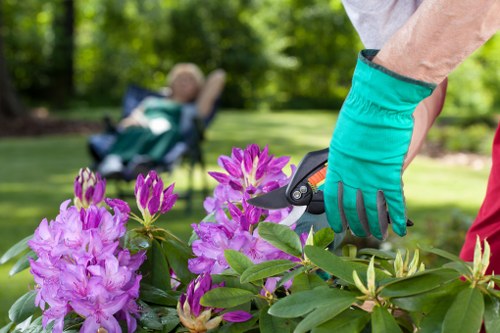 Community engagement and training is part of our sustainability model. We run voluntary workshops with local community groups and collaborate with conservation charities to host planting and composting days in Millbank green spaces. These events amplify our recycling objectives and help residents understand how simple changes — such as keeping soil and pots separate from general waste — contribute to meeting our 75% recycling percentage target.
 In conclusion, our Millbank hedge trimming and sustainable waste practices aim to set a local standard: a low-carbon fleet, strategic use of authorised transfer stations, strong charity partnerships and an iron-clad recycling target. By integrating the boroughs’ waste separation approaches into everyday operations, by prioritising reuse and by reporting transparently on progress, we create an eco-friendly waste disposal area and a robust sustainable rubbish gardening area for the community. Together with residents, councils and charity partners, our goal is to close the loop on green waste and keep Millbank’s hedges healthy, its emissions low, and its green spaces thriving.